Key Takeaways
- Cottage food bakers consistently underprice — often earning below minimum wage
- Use cost-plus pricing: ingredients + labor + packaging + overhead + profit
- Decorated sugar cookies realistically cost $5-$8 each when labor is included
- If your state has a revenue cap, pricing higher is the only path to livable income
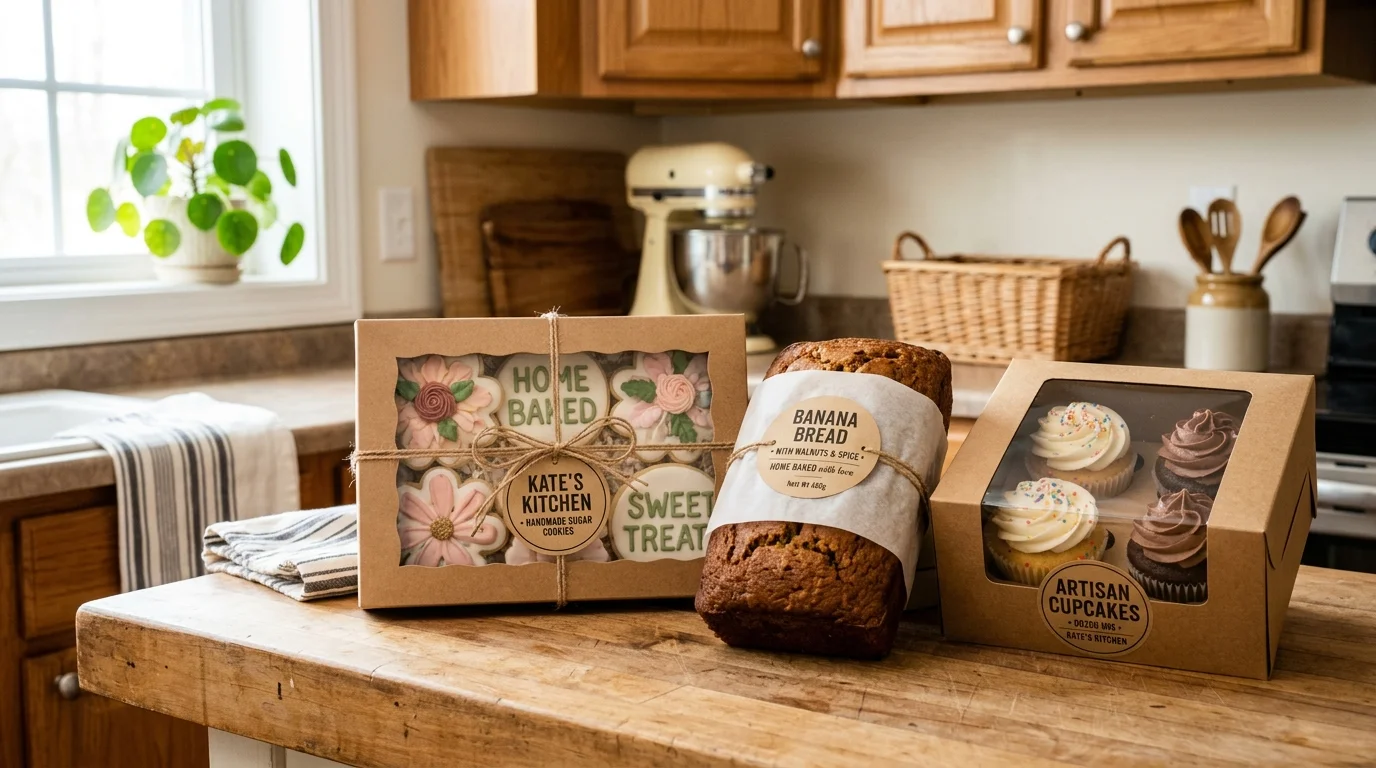
Cottage food laws exist in every U.S. state, allowing home bakers to sell certain baked goods directly to consumers without a commercial kitchen. The laws vary wildly — annual revenue caps range from $5,000 in some states to unlimited in others, and the list of allowed products differs everywhere — but the pricing challenge is universal: cottage food bakers consistently underprice their work.
This guide is specifically for home bakers operating under cottage food laws. If that is you, the single most valuable thing you can do today is re-examine your prices with fresh eyes.
The Underpricing Trap
We talk to cottage food bakers every week, and the conversation almost always starts the same way: "I love baking, but I am not making any money." When we look at their prices, the problem is immediately obvious. They are charging $15 for a dozen cupcakes that took two hours to make and cost $6 in ingredients.
The $15 Cupcake Dozen — Where the Money Goes
At 2 hours of work, that is $3.38 per hour. Below the federal minimum wage of $7.25 in every state.
The reasons bakers underprice are predictable and understandable, but they need to be confronted directly:
- "I am just a home baker." Your kitchen location has no bearing on the quality of your product or the value of your time. A cupcake baked in a home kitchen tastes the same as one baked in a commercial space.
- "I do not want to charge more than the grocery store." You are not competing with the grocery store. Grocery store cupcakes are mass-produced with shelf-stable ingredients. Your product is fresh, handmade, and customizable. They are different products.
- "My friends and family expect a deal." Friends and family who do not respect your business prices are not your target customers. Offer a modest 10% friends-and-family discount if you want, but never below cost.
- "Nobody around here will pay that much." You might be surprised. Test higher prices with your next batch. If you lose zero customers, you were underpriced. If you lose a few, you may still come out ahead on margin.
How to Price Cottage Food Products
Use the same cost-plus method that commercial bakers use. The fact that you bake at home does not change the math — it just changes some of the line items.
Selling Price = Ingredients + Labor + Packaging + Overhead + Profit
Ingredients
Calculate the exact cost of every ingredient in the recipe. Not a rough estimate — the actual cost, converted from purchase units to recipe units, including tax where applicable. If you buy a 5 lb bag of flour for $3.99, you need to know that 2.25 cups costs you $0.42.
Labor
This is the line item most cottage food bakers skip entirely. Your time has value. Set a minimum hourly rate for yourself — $15 to $25 per hour is a reasonable starting range depending on your market. Track how long each product actually takes, including prep, active baking time, decorating, cooling, and packaging.
Labor Time Estimation — Common Products
These are active labor times. They do not include passive bake or cool time, but they do include cleanup.
Packaging
Cottage food laws in most states require specific labeling (producer name, address, "Made in a home kitchen" disclaimer, ingredients list, allergens). Factor in the cost of boxes, bags, labels, stickers, tissue paper, and any presentation materials. A typical packaging cost is $0.50 to $3.00 per unit depending on the product.
Overhead
Even without commercial rent, you have overhead. Running your home oven costs roughly $0.15 to $0.50 per hour in electricity or gas. Your stand mixer cost $300+ and will need replacement eventually. You pay for dish soap, parchment paper, and food-safe gloves. A reasonable overhead allocation for cottage food is 5-8% of revenue.
A Complete Pricing Example
Let us price a dozen decorated sugar cookies — one of the most common cottage food products and one of the most commonly underpriced.
1 dozen decorated sugar cookies
Per cookie: $6.92
Yes, that is $83 for a dozen decorated sugar cookies. That number shocks many home bakers, but it reflects reality: decorated sugar cookies are extremely labor intensive. The ingredient cost is only $5.60, but 3 hours of skilled decorating work at a modest $20/hr adds $60. This is exactly why decorated cookies sell for $5 to $8 each at farmers markets and on social media — the bakers who survive are the ones who charge enough to cover their time.
Cottage Food Revenue Caps and Pricing Strategy
If your state caps cottage food revenue — say at $50,000 per year — pricing becomes even more important. You have a fixed ceiling on how much you can sell. Every dollar you underprice is a dollar you can never recover because you cannot simply make up the volume.
Same revenue cap, different pricing strategies:
At $2.50/cookie: 20,000 cookies to hit $50k cap = 385 cookies/week
Unsustainable volume for a home kitchen
At $6.00/cookie: 8,334 cookies to hit $50k cap = 160 cookies/week
Difficult but manageable
At $7.50/cookie: 6,667 cookies to hit $50k cap = 128 cookies/week
Realistic for a dedicated cottage food operation
Higher prices mean fewer units needed, less wear on your equipment, less time spent baking, and more profit per hour worked. When you have a revenue cap, pricing up is the only path to a livable income.
Your Time Matters Even If You Bake from Home
This is the message we want every cottage food baker to hear: your time is not free just because you are at home. Every hour you spend baking is an hour you could spend on something else. Economists call this opportunity cost, but you do not need an economics degree to understand it. If your baking business pays you $5 an hour after expenses, you would earn more working part-time at a coffee shop.
Price your products like the professional you are. Track your ingredient costs so you know your true expenses. Account for every hour of labor. And raise your prices before you burn out from overwork and underearning. Your baked goods have real value — make sure your prices reflect it.
Sources
- National Agricultural Law Center — Cottage Food Laws by State
- Forrager — Cottage Food Sales Limits by State
- Farm-to-Consumer Legal Defense Fund — Cottage Foods Map
- U.S. Department of Labor — Federal Minimum Wage
All prices, costs, and calculations in this guide are for illustrative purposes only. Cottage food laws, revenue caps, and labeling requirements vary by state and change frequently. Always check your state's current cottage food regulations and use your own real costs when setting prices.