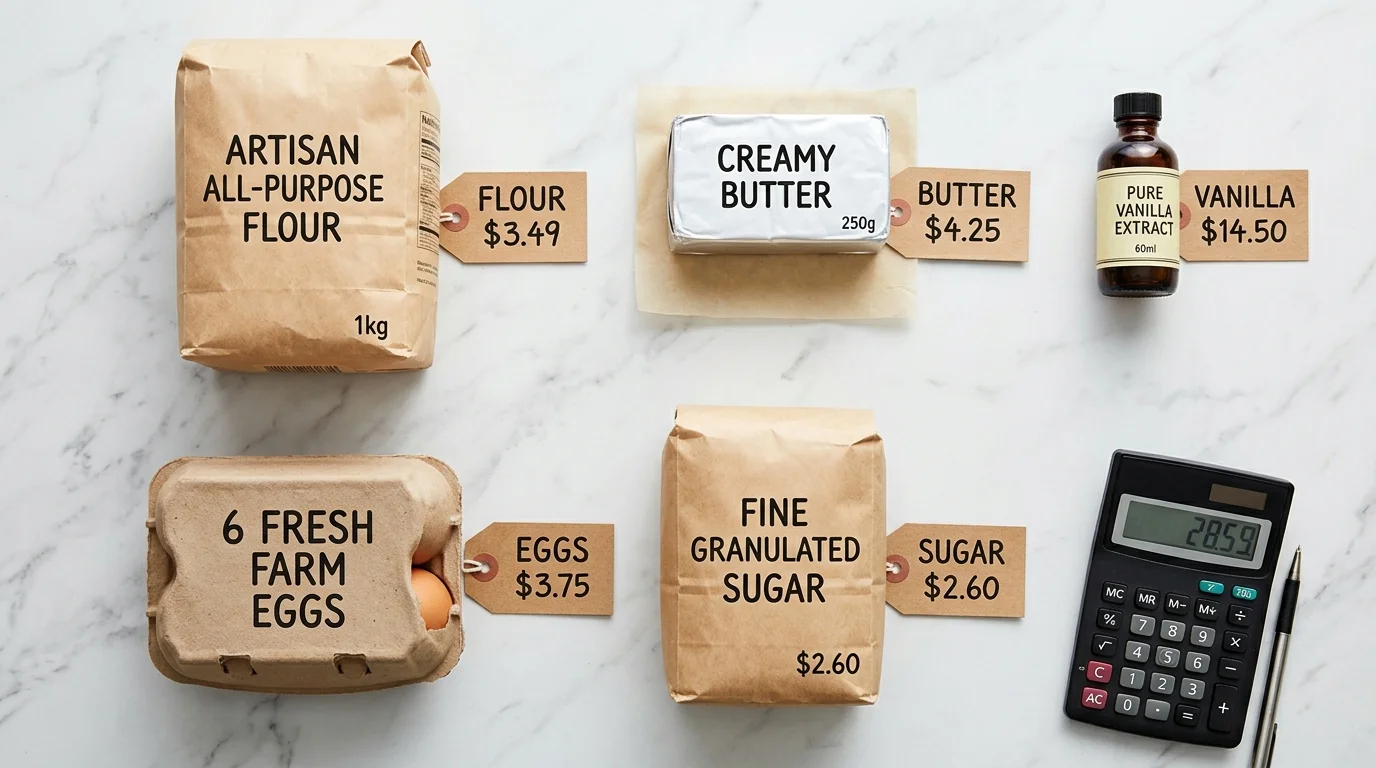
Key Takeaways
- Food Cost % = (Ingredient Cost / Selling Price) x 100
- Most bakeries target 25-35% food cost depending on product type
- A low food cost does not guarantee profit — labor can eat the rest
- Review your food cost quarterly and raise prices before margins erode
If you only learn one number in your baking business, make it your food cost percentage. It tells you, at a glance, whether your prices are sustainable or whether you are slowly losing money with every sale.
The Formula
Food Cost % = (Total Ingredient Cost / Selling Price) x 100
That is it. One division and one multiplication. But this single number reveals whether your pricing is healthy, tight, or underwater. Let us walk through what it means in practice.
What Does Food Cost Percentage Actually Tell You?
Your food cost percentage represents how many cents of every dollar you earn go directly back to buying ingredients. If your food cost is 30%, then $0.30 of every $1.00 in revenue pays for flour, sugar, butter, and everything else that goes into your products. The remaining $0.70 has to cover labor, packaging, overhead, taxes, and your profit.
This is why a food cost of 50% or higher is a red flag. At that point, half your revenue is consumed by ingredients before you pay yourself a single cent.
What Is a Good Food Cost Percentage?
There is no single right answer because it depends on your product type, labor intensity, and business model. The National Restaurant Association reports that food costs represent a median of 31-34% of sales across food service businesses. Here are the ranges we see across baking specifically:
Notice that wedding cakes and custom cakes have the lowest food cost percentages. That is not because the ingredients are cheap — it is because the selling price is high enough to reflect the hours of skilled labor involved. Bread sits at the other end: the ingredients are inexpensive, but so is the selling price, which compresses the ratio.
Worked Example 1: Cupcakes
You bake a batch of 12 vanilla cupcakes. After carefully tracking every ingredient, your total cost is $4.80 for the batch. You sell them for $1.50 each, or $18.00 per dozen.
Food Cost % = ($4.80 / $18.00) x 100
Food Cost = 26.7%
This is healthy. You have 73.3% of revenue remaining for labor, packaging, overhead, and profit.
Worked Example 2: Custom Layer Cake
A three-layer 8-inch cake with buttercream and fondant decorations. Ingredient cost is $12.50 (cake layers, buttercream, fondant, food coloring, board, and box). You charge $85.00.
Food Cost % = ($12.50 / $85.00) x 100
Food Cost = 14.7%
This looks very low, but it accounts for the 3-4 hours of decorating labor that the selling price must cover. At $85 with $12.50 in ingredients, you have $72.50 for labor, overhead, and profit. If the cake takes 4 hours, that is $18.13 per hour before overhead — reasonable, but not extravagant.
Worked Example 3: Sourdough Bread
A single loaf of sourdough uses roughly $1.10 in ingredients (flour, water, salt, and a portion of your starter maintenance cost). You sell it for $7.00.
Food Cost % = ($1.10 / $7.00) x 100
Food Cost = 15.7%
Looks great on paper, but sourdough has hidden time costs: maintaining your starter, long fermentation, multiple folds. If you factor in 20 minutes of active labor per loaf at $20/hr, that adds $6.67, bringing your total cost to $7.77 — above your selling price. This is why food cost alone does not tell the whole story.
The Trap: Low Food Cost Does Not Mean High Profit
This is the most important nuance. A low food cost percentage does not automatically mean you are profitable. It just means ingredients are a small portion of your revenue. If your labor costs eat up the rest, you can have a 15% food cost and still lose money on every item.
Food cost percentage is a screening tool, not the final answer. Use it to identify products that are clearly underpriced (anything above 40% food cost should be re-evaluated immediately), and then dig deeper into labor and overhead for a complete picture.
How to Improve Your Food Cost
- Buy in bulk where it makes sense. A 25 lb bag of flour is significantly cheaper per pound than a 5 lb bag. But only buy what you will use before it goes stale.
- Track prices across suppliers. BLS data shows butter prices can vary 20-30% between warehouse clubs and grocery stores.
- Reduce waste. Measure precisely. A recipe that calls for 2 cups of chocolate chips does not need a generous 2.5 cups. Over a year, that generosity adds up to hundreds of dollars.
- Raise prices before you are desperate. A 5% price increase is almost invisible to customers. Waiting until you need a 20% increase creates sticker shock.
- Review quarterly. Ingredient costs change. Your food cost percentage drifts if you do not recalculate it.
Sources
- National Restaurant Association — Food Cost Ratios in 2024
- Bureau of Labor Statistics — Average Price: Butter, per lb.
All prices, costs, and calculations in this guide are for illustrative purposes only. Actual ingredient costs vary by location, supplier, season, and market conditions. Always use your own real purchase prices when calculating recipe costs and setting prices.